
When Modesty Becomes Provocation
What is modesty, really? In English, we use one word to describe different kinds of restraint — whether it’s in how we speak about our wealth, beauty, knowledge, or how we carry our bodies. But in French, there are separate words that help us distinguish these layers: modeste describes someone who doesn’t boast about what they have; pudique refers to someone who maintains physical and emotional reserve; and humble captures a deeper internal disposition of humility.
In today’s world, modesty is still praised — but mostly the kind that doesn’t disrupt. We celebrate modesty in speech or success, but modesty of the body? That has become controversial. A woman who doesn’t brag is considered virtuous. But a woman who covers for the sake of God is considered suspicious — or worse, repressed.
And let’s also be honest: while modesty is for everyone, its expectations fall more heavily on women. Yes, Islam requires men to lower their gaze and dress modestly too — but the rules for women are more defined. Some claim this is because women are “the weaker sex,” a term long used in French — le sexe faible. But perhaps it doesn’t mean weakness in ability or intellect. Perhaps it refers to something else.
Because if women are the “weaker” sex, then what are men? The opposite: le sexe fort — not stronger in character, but more vulnerable to their own desires. More easily provoked by what they see. More in need of spiritual discipline to control their gaze and their impulses.
“Tell the believing men to lower their gaze and guard their private parts. That is purer for them. Surely Allah is All-Aware of what they do.”
(Surah An-Nur 24:30)
This verse comes before the command to women in verse 31, showing that the first moral responsibility lies with men — to guard their gaze and desires.
“I have not left behind me any fitnah more harmful to men than women.”
(Sahih al-Bukhari 5096, Sahih Muslim 2740)
The Prophet ﷺ warned his ummah not of women themselves, but of the way men fail to restrain their own nafs. This isn’t a blame on women — it’s a wake-up call to male self-control, and a reminder for women to protect their brothers in God by embodying dignity, restraint, and compassion in how they present themselves to the world.
So when a woman covers, she’s not just protecting herself. She’s also helping to preserve the moral fabric around her. That’s why modesty matters. And that’s why it unsettles people.
Modesty shouldn’t provoke resistance. But somehow, in this modern world, it has become a threat.
And yet, the choice to be modest — especially for women — continues to spark discomfort and debate. A woman who chooses to cover, not because of fear or shame, but out of reverence for her Creator, is often met with suspicion, discomfort, or mockery. And what’s most alarming is that these reactions come not just from secular societies, but from within Muslim-majority cultures too.
This isn’t about fabric. It’s about faith. Because what people fear is not the veil, the burkini, or the refusal of a handshake — it’s the God-consciousness that these choices embody. It’s also about control — because when someone obeys God, they are no longer as easily manipulated by the systems of this world. Modesty threatens not just norms, but power. It removes a person from the grip of the matrix — from the illusion that we must answer to people, trends, or corporations. A modest woman says with her body: I do not belong to you. And that terrifies those who think they rule.
What follows are three moments — three reflections — that highlight different dimensions of modesty: the difficulty of holding your ground in a professional setting, the hypocrisy of secular coverings, and the unease sparked by visible faith. Together, they reveal not just the challenges of being modest in today’s world, but also the power of what modesty disrupts.
The Fractional Second: A Handshake That Lasted Too Long
There’s a fraction of a second — the space between an extended hand and your next breath — where your soul is tested.
You’ve prepared yourself. You rehearsed your lines. You know what your Lord expects.

But the moment comes unexpectedly — after you let your guard down, after the meeting is wrapping up, after the small victory of keeping everything “professional.”
And suddenly, the handshake appears.
You say “yes” with your hand when your heart wanted to say “no.” And what makes it more painful is knowing that not long ago, during the height of the pandemic, people refused handshakes altogether — not out of modesty or conviction, but out of fear. People bumped elbows, invented Wakanda-style greetings, or gestured from a distance — all out of respect for a virus. But today, if you say ‘no’ for God, it feels almost offensive.
This happened to me. And it reminded me how hard it is to practice Tawḥīd — full spiritual alignment — not just in prayer, but in posture.
It wasn’t just about the handshake. A male realtor came to view my house — a house I bought with riba (interest), which I now seek to sell as part of my spiritual cleansing. But I live alone. I don’t have a maḥram. Not here in Canada. Not even back in Africa.
Was I doing something wrong by letting a man inside? I dressed appropriately. I invoked protection. I made duʿāʾ. I stayed mindful. I took every measure I could.
But is it enough?
Am I falling short?
I had the upper hand — he wanted my business. So why didn’t I just say no?
Because my guard was down. And modesty requires vigilance. It’s not just a headscarf — it’s a full-body presence of God.
That day taught me how fragile our resolve can be when we are unguarded — and how modesty is not a passive state, but an active practice of remembering Allah in every interaction. Because at its core, modesty draws from taqwa — and taqwa, like modesty, is not fixed. It changes with context. Even the Prophet ﷺ was instructed repeatedly by Allah to have taqwa, because taqwa is something we must renew based on where we are, who we’re with, and what we’re about to face. Before stepping into a new space, a new meeting, a new situation, a person of taqwa prepares: not just with information, but with spiritual awareness. That moment of spiritual readiness is part of modesty too.
Pandemic Parable: The Day Everyone Wore Niqāb
I was sitting in my car outside the grocery store, parked and watching the world move in slow motion. It was deep winter in Canada — real winter. The kind of cold where everyone looks like a walking onion: wrapped in layers upon layers, hood pulled over the head, scarves tight around the face, sometimes only a sliver of skin visible between hat and collar.
That day, everyone wore a mask too — government-mandated. So now all you could see were eyes. Suddenly, the whole parking lot looked like a Muslim woman in niqāb.
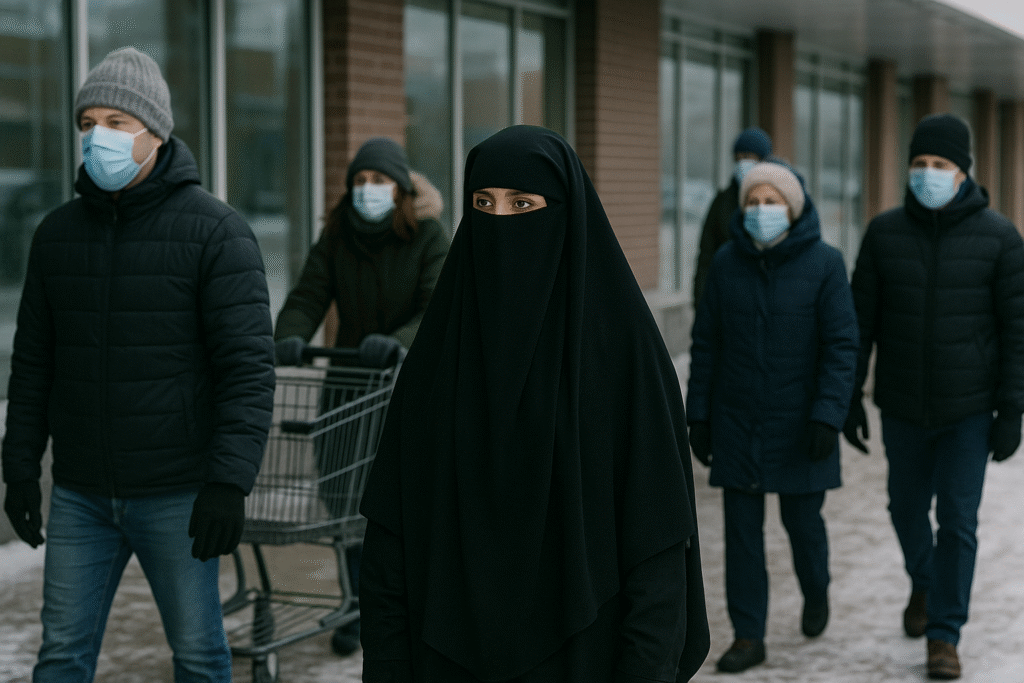
Men. Women. Teenagers. Elderly. No one questioned it. No one mocked it. No one feared it. Why? Because this time, it wasn’t for God — it was for a virus.
And that’s when it hit me: the niqāb wasn’t the problem — faith was.
Because when it was done for Allah, it was seen as oppression. But when it was done for public health, it was seen as intelligence. Compliance. Responsibility.
It made me wonder: do we really hate the fabric, or do we hate the faith that commands it?
Muslim women were fined, fired, and publicly ridiculed in countries like France and Quebec for doing exactly what society later mandated. The same veil that once “scared” people suddenly became your duty. Your protection. Your civic virtue.
How strange.
The pandemic exposed so much — not just our lungs, but our hypocrisy. It showed that people are perfectly capable of covering up. But they’ll only do it if the reason is secular. If the purpose is worldly. If the fear is death — not God.
And when the virus started to fade, so did the modesty. The masks came off, the touch returned, and we forgot the lesson.
But I still remember that day in the parking lot.
Because it showed me — modesty was never the problem.
The Beach Paradox: When the Problem Is Not the Skin
Picture this:
You’re on a beach — somewhere modern, liberal, “free.” It could be southern France. It could be a hotel resort in Senegal. The sun is shining. The sea is calm. People are relaxing.
You look to your right: there’s a woman in a monokini — bare chest exposed, tanning freely. No one bats an eye. In fact, people move around her without judgment. Some might glance. Some might not even notice. She’s not disrupting anything.
Then you look to your left: a Muslim woman walks onto the same sand, wearing a burkini — full-coverage swimwear designed for modesty. Suddenly, the atmosphere changes. People stare. Some sneer. Others whisper.
She’s the problem.
Not the skin that’s exposed — but the one that’s concealed.
She hasn’t spoken. She hasn’t imposed. She’s not even swimming yet. But her presence alone makes people uncomfortable.
Why?
Because her covered body reminds people of God. And not everyone wants to be reminded.
She is not just wearing fabric. She is carrying a worldview. And that worldview — one of modesty, accountability, and reverence — clashes with the illusion of freedom that people want to preserve.
So they do what people often do when they feel convicted but not ready to change — they ridicule.
But isn’t that ironic?
A woman who exposes her chest is “liberated.”
A woman who covers her body is “oppressed.”
And the line between the two isn’t skin.
It’s submission.
What all of this makes clear is that modesty, when done for Allah, becomes a kind of mirror — one that reflects back to others what they are trying to avoid. And when people cannot break the mirror, they try to silence the one holding it.
The Price of Being a Reminder
What society truly fears is not fabric, not coverage, not even religion itself — but reminders. And every modest woman is a walking reminder that there is a higher accountability. That we are not just bodies, but souls in trust. That beauty has boundaries.
And yet, as a society, we still act as if there’s no consequence when a woman walks bare-chested in front of others — as if this doesn’t impact men and boys or affect the self-image of other women and young girls who are already under siege by a culture obsessed with exposure, validation, and comparison. But it does. It feeds desire. It disorders the gaze. It fractures self-worth. We just choose not to talk about it.
Ironically, that same woman, if she were to walk topless through a corporate office or down a public street, would be stopped — even fined — for what’s legally referred to as an “indecent act” or indecent exposure. In Quebec and other regions, modesty is still legally protected — but only when it comes to what’s exposed, not what’s concealed.
Meanwhile, the woman in a burkini — fully covered, harming no one — is the one made to feel like the intruder. Not because she’s indecent, but because she reflects a standard some people no longer want to see. That freedom isn’t found in exposure, but in submission.
In the Qur’an, Allah says:
“And tell the believing women to lower their gaze and guard their private parts and not expose their adornment…”
(Surah An-Nur 24:31)
This is not a restriction — it’s an honor. A divine invitation to rise above the gaze of creation and live under the gaze of the Creator.
So no, I will not apologize for being modest.
I will not shrink my boundaries to make others feel comfortable in their own.
And I will not allow discomfort to silence devotion.
Because modesty is not a weakness.
It is a shield.
A flag.
And sometimes, a sword.
🤲🏽 Reflection Duʿāʾ: Ya Sattār, Ya Wadūd…
This closing duʿāʾ is part of Observance’s original reflections. It is not taken from any Hadith or Qur’anic text but expresses a sincere, faith-rooted plea rooted in spiritual themes discussed above.
- O Allah, cover us in Your mercy, as we try to cover ourselves for Your sake.
- Give us the strength to choose You in every uncomfortable moment, every silent refusal, every step away from what displeases You.
- Let our modesty be light, not burden — a reminder, not a reason for ridicule.
- Let us walk in dignity, even when the world walks away from us.
Allahumma ameen.
اللَّهُمَّ آمِين
📚 References
- The Holy Qur’an, Surah An-Nur (24:30–31)
- Sahih al-Bukhari, Hadith 5096
- Sahih Muslim, Hadith 2740
Additional reflections informed by contemporary observations of pandemic behavior, modesty discourse, and societal double standards experienced or witnessed in North American and West African contexts.
Leave a Comment